


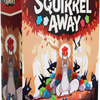
Designer Diary - Squirrel Away

by Clarence Simpson (Designer of Squirrel Away)
The beginning of Squirrel Away was magic. No...I mean, like, David Copperfield magic.
A Seed of an Idea
As a teenager, I went through a phase in which I was fascinated with illusions and magic tricks. I would periodically go to the magic shop in town and watch the local magicians demo amazing tricks. I would buy some of the gimmicks they used, practice the banter and sleight-of-hand that made everything work, then show off my tricks to friends at school.
Performing a magic trick, and fooling your audience, is exhilarating. The amazement you see on people's faces is an experience that's tough to replicate anywhere else — and it was something I forgot about for a long time.
I don't do much magic anymore, but in recent years, the YouTube algorithm has been pushing videos of magicians to me, and I've been taking the bait because I do enjoy trying to figure out how a trick is done. Did they really put that card in that hand? Were they actually holding that coin in their palm for the past five minutes? Did they just grab something completely different from what it looked like they grabbed?
:strip_icc()/pic9187831.jpg)
Some of that fascination with magic came back to me, but now I was in my Game Design Era, so I set a challenge to myself: to see whether I could put sleight-of-hand and that feeling of fooling everyone around you into a tabletop game.
Look at All These Shinies!
In 2019, shortly after I started doing game design seriously, I built up a collection of bits that I would use in prototypes. I bought cubes, meeples, dice, etc. I also stumbled across a bag of colored acrylic gems online that reminded me of the gems in Incan Gold, one of my favorite games, so I ordered them. Only after the package arrived at my door did I realize how much bigger the gems were than the ones in Incan Gold.
:strip_icc()/pic9187842.jpg)
Okay, they weren't exactly what I wanted, but I could still make use of them, right? I kept trying to use them in my prototypes since they were pretty, but some other smaller token would usually do the job better because if you had more than five or so of them, they started to feel unwieldy with how much space they took up.
Literally years went by, and I still couldn't figure out what to do with these gems. They looked great but felt like a huge waste, and I hate wasting things. They were too big to use as any sort of sensible token in a game.
I wondered whether there was some context in which their specific large size could be critical to the game somehow, like the game wouldn't work if they were smaller. That's when I thought about holding them in your hand as some sort of core mechanism. You could hold a good number of gems in your hand, but there was also a reasonable maximum because of how big they were. Maybe you could guess how many gems someone has in their hand? Maybe players want to fool others about what they have in their hand?
That's when I remembered my self challenge to put sleight-of-hand into a game, and the light bulb went off.
Scoundrel!
After that realization, things fell into place quickly. I decided to make a game about a band of jewel thieves that just pulled off the heist of a lifetime, and it's now time to split the loot — but being thieves, everyone was willing to lie, cheat, and steal to get the biggest share of that loot.
That first prototype looks remarkably like the final product. There was always a pile of four types of gems in the center of the table, a deck of "share" cards that told you which gem types were your share of the loot, bluffing to get more than what's shown on your share cards, other players calling your bluff, and scoring by collecting sets of one of each gem type.
Two early design pillars I set for the game was that I wanted it to be highly accessible and to spark laughter. In service of that, whenever players called out a bluff, I wanted them to point and shout, calling the other player some derogatory term that was also whimsical and maybe a bit anachronistic. I considered words like "rapscallion", "rogue", "rascal", and also more straightforward terms like "liar" and "cheater", but nothing felt quite as punchy or ear-catching (is that a word?) as "scoundrel". I could imagine walking past tables at a con, overhearing someone shout "SCOUNDREL!!!" in a semi-serious, semi-playful tone, then thinking, "That sounds fun! What's that all about?" So "Scoundrel" stuck and also became the name of the game.
:strip_icc()/pic9187908.jpg)
A mechanical hook that was present from the beginning was the two different styles of bluffing. On your turn, you play a share card face-down, grab some gems and hold them in your hand, then announce what you took. If you were being truthful, this meant all three things (card, gems, and what you say) would match, which therefore provided two different vectors for bluffing. You could lie about what was on your card, or you could lie about which gems were in your hand. One was a mental challenge common to many bluffing games; the other was a physical challenge that encouraged players to dabble in sleight-of-hand. When other players called "Scoundrel" on you, in order to catch you, they had to decide which of those two things you were lying about. I was fairly confident that no other bluffing games did this, and it felt like a unique twist to put on the genre.
With those basics in place, it was time to put it on the table and see what happened. Sometimes a designer can do solo playtesting by playing the part of multiple players. That wouldn't work with "Scoundrel", though, so in April 2023 I brought "Scoundrel" to the next meeting of the Game Designers of North Carolina.
Sunshine and Water
I was fully prepared for a game with such an unusual core system to immediately fall apart in playtesting — but at that first playtest, I quickly realized that the concept totally worked! Players were able to grab some physical gems from the center of the table without everyone knowing what was grabbed.
Best of all, it was shockingly easy to do! Players who thought they had no chance of succeeding when I described the sleight-of-hand mechanism to them were able to do it, and the feeling of getting away with extra gems because you were physically sneaky and stealthy while others watched you was unique and amazing.
I immediately knew that the core was solid as-is, but it still had a few rough edges, so it was time to start refining things and growing "Scoundrel" into a game that was ready to pitch.
Like real sleight-of-hand, I wanted there to be some element of skill to it. I wanted players to be able to get better at it with time and practice, learning more tricks of misdirection or adding more creative and performative aspects if they wanted to. But I also knew the design needed to stay accessible to a broad audience — and players should feel comfortable sharing it with even the most casual of gamers. In the back of my mind, I did have a dream that someday my game would be played by close-up magicians using all their sleight-of-hand trickery to show off the skill ceiling of the game, but I didn't want it to be playable only by magicians.
:strip_icc()/pic9187853.jpg)
Some players felt a little lost about exactly how to do the sleight-of-hand piece, so I took note of the best tricks people pulled, things like pushing the gems around before you grab to get them in a better position, dropping a few gems after you grab them, and (my favorite) grabbing gems while everyone is still laughing about the last turn. I started giving these examples during the teach and explicitly listed them in the rulebook. This helped to highlight the potential creativity in the game and to spark the imagination of players who didn't know what kinds of things to try.
Originally, the share card deck included every combination of 2-3 gems, but that made for too many possibilities, and the 3-gem cards felt so much better than the 2-gem cards. To simplify the deck and help with balance, I made all the 2-gem cards be two different gems and all the 3-gem cards be three of the same gem. Now, getting three gems wasn't necessarily better because each gem may not bring you closer to completing a set of all four gems, which was needed to score. On the other hand, each 2-gem card meant you were halfway to a complete set.
The initial version of the game had no wild cards, but after that first successful test, I wanted to inject more big moments, so I added a few wild cards that would let you take two or three gems of whatever type you needed. They were powerful cards, but also, anyone could claim to have them. After that, any time someone said they were playing a wild card, it often led to those great moments of squinty-eyed skepticism that are the bread and butter of bluffing games.
:strip_icc()/pic9210344.png)
The most iteration in the game revolved around what to do when resolving a "Scoundrel" call. If the caller is right, what reward should they get and what penalty should the scoundrel get? Similarly, what happens when the caller is wrong? This was a delicate balance of incentives to juggle. You had to want to call "Scoundrel" on people, but not all the time or for frivolous reasons.
There also had to be enough incentives and disincentives to bluffing that you were too scared to do it all the time, but not too scared to never do it. There was no perfect answer to the issue, but I'm happy with where we landed with it.
The Long Winter
Once I was convinced that I had a unique hook and that the game was fairly refined and doing the things I wanted it to do, I was ready to show it to publishers! In June 2023, I started doing e-mail pitches and setting up pitch meetings for my trip to Origins that year. I had several good meetings and contacts with publishers that I thought would be a great fit, including a major mass-market publisher that was highly intrigued and wanted to test it with their own playtest groups.
I spent about six months in a holding pattern, waiting for that mass-market publisher to finish their evaluation. Unfortunately, although they liked the game, they ended up deciding it wasn't a good fit for their audience, so it was time to get back to pitching to a new batch of publishers. And this time, I was going to do it at GAMA Expo!
For its 2024 show, GAMA Expo was relocating to my side of the United States. That turned an expensive cross-country flight into a long, but cheap, day of driving. The event was also revamping its programming for game designers by adding a "Designer Day" with lots of panels and talks about design, as well as networking events.
Before those changes, it was fairly tough to sell GAMA Expo as being a worthwhile con to attend as an independent designer on the East Coast — but suddenly I was very intrigued, so I decided to go see what GAMA was all about.
:strip_icc()/pic9187919.jpg)
GAMA Expo is now one of my absolute favorite cons for pitching and networking. Not being a consumer-facing con gives it a massive advantage in how accessible and relaxed publishers are because they're not dealing with a flood of customers every day. It's a much slower pace than any other con I've been to, which is nice — and, most importantly, it led to "Scoundrel" being signed!
The Floodgates Open
While at GAMA for the first time in March 2024, I decided to go to the Floodgate Games booth and introduce myself to the owner, Ben Harkins. Ben knew something of my previous work, which is always helpful when starting these conversations. After chatting a bit, I pulled out my "Scoundrel" prototype to show him.
Ben was intrigued, but also highly skeptical that the core sleight-of-hand concept would work while also being accessible to a broad audience of people...but he was willing to give it a shot. Soon after GAMA, I assembled a prototype and mailed it to him. After giving it a few rounds of playtesting, he was convinced that it actually did what I said it would do and offered to publish the game!
Development kicked off soon after, and we tossed around various small tweaks to the game. We discussed adding cards with special abilities, getting rid of the "Scoundrel" tokens, alternate card distributions, alternate wild cards, and alternate scoring methods. Almost none of these ideas made it into the final product. They each had their various benefits, but they mostly also made the game less elegant. In the end, we decided to lean into that elegance, and the final product is mechanically almost identical to the prototype that I originally pitched.
:strip_icc()/pic9187917.jpg)
A big part of the fun of the game was figuring out how exactly to fool your opponents and get away with your haul. You could touch lots of gems to confuse what you're actually taking. You could even pull the classic "Look over there!" and point across the room. You could also just choose to grab gems quickly while people were still laughing about the previous turn.
This, in particular, turned out to be a great, fun strategy. It would happen organically from time to time, but kudos to Ben for pushing to make it explicit. The rulebook specifically allows players to start their turn just before the previous player's turn was completely finished, which can lead to hilarious moments.
Let’s Get Nuts!
With all the mechanical discussion taking place, there was still one major aesthetic decision that remained. Ben wanted to retheme the game into something with broader appeal than jewel thieves, so he proposed making the game about squirrels stealing acorns.
Now it was my turn to be skeptical. I'll be honest — I was really not on board with this change at first. Even though no mechanical changes were involved, I couldn't see Ben's thematic vision. I imagined boring little cartoon squirrels that would make the game read like a children's game, when I knew the mechanisms could also appeal to adult gamers.
:strip_icc()/pic536644.jpg)
But it's important to be aware of your strengths and weaknesses as a designer, and marketing and product design are not exactly my forte, so I told Ben that I would trust him to know his audience and how to make a product that would appeal to them. Thus, "Scoundrel" became Squirrel Away.
Eventually, Ben brought on David DePasquale to do the art for the game, and as soon as I saw David's rough pass at the cover art, I was sold. All my concerns were put to rest with those adorable, mischievous squirrels on the cover. They were filled with character and personality. They had managed to strike a perfect balance of cute but not childish, and in conversations with friends and colleagues, many preferred the retheme.
:strip_icc()/pic9187889.jpg)
Some months later, Squirrel Away made its early debut at Gen Con 2025. It had been a little over a year since signing the game with Floodgate and two-and-a-half years since I had that light bulb moment of combining these chunky gems with my love of magic and sleight-of-hand. In a full-circle moment, Ben even hired a real-life close-up magician, Michael OJ, to perform in the booth with my game.
At this point, Squirrel Away debuted at SPIEL Essen 25 and hit retail outlets in late October 2025. I'm looking forward to more people getting their hands on the game and seeing the creative ways that they come up with to distract from and disguise their nefarious acorn snatching.
Thanks for reading about the game's journey, and I can't wait to see it on your tables!
Clarence Simpson
:strip_icc()/pic9187894.jpg)


Leave a comment